Resources and Advice
On this page you will find a wealth of information about Gamblin Conservation Colors from a FAQ section to highly technical sections that include the scientific paper behind the development of GCC and the SDS.
FAQ, Tips, Advice
What are Gamblin Conservation Colors made from?
Gamblin Conservation Colors are made from Laropal® A-81 which is a trademarked resin of the BASF Group, lightfast pigments, and a mixture of solvents.
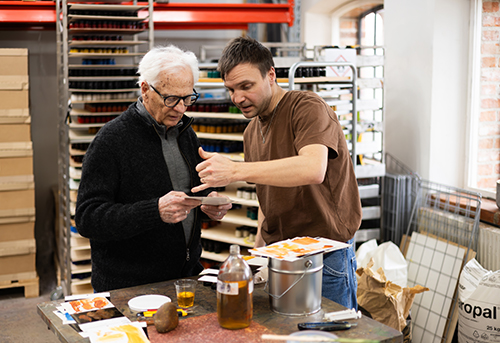
Tell me more about the Laropal® resin …
Laropal ® A-81 is a synthetic low molecular weight urea-aldehyde resin. Its special characteristics are:
- photochemical stability
- excellent pigment wetting
- working properties similar to a natural resin medium.
After aging for 3000 hrs. in a weatherometer at the NGA Washington D.C., solubility of the resin changed only slightly. The resin is soluble in solvents of low polarity both during working and after it is aged.
What solvent should I use for my inpainting?
The solvent that you bring to the inpainting process is very important to the experience of inpainting. All solvents recommended below will do the job of diluting the color, but each one will have a different evaporation rate. This will control how much time you have to do your application and blending. The list below is pretty complete, but we have found that most conservators and restorers that we have discussed these issues with are happy with the working properties provided by using isopropanol.
Here are suggestions that conservators have given us of the solvents they commonly use with Gamblin Conservation Colors:
- Isopropanol (99% pure) → CAS # 67-63-0
- “Everclear” or “Gemclear” or other 95% grain Alcohol → CAS # 64-17-5
Suggestions from European Conservators:
- Methoxypropanol → CAS # 1320-67-8
- Ethyl Lactate
- Mixture of Ethyl Lactate and Isopropanol
- Diacetone Alcohol → CAS # 123-42-2
- (2:3) Mixture of Ethanol to diacetone alcohol
- 40% ethyl lactate, 30% ligroin, 30% ethanol
Suggested Solvents from the BASF technical data sheet, the maker of Laropal® A-81:
- Methoxy propyl acetate, (PM Acetate, or Glycol Ether PM Acetate) → CAS # 108-65-6
- Mineral Spirits of 40% aromatics
What is the gloss level of Gamblin Conservation Colors?
Gamblin Conservation Colors dry fairly matte.
- This is good since most paintings being restored are matte after the old varnish has been removed, the fresh inpainting will take a final varnish similarly to the rest of the painting.
- To keep the gloss level of the inpainting low, dilute the colors with small amounts of solvent only.
- To increase gloss, dilute the colors with some portion of Galdehyde Resin medium, this is the binder for the colors. This is your best approach when the surrounding original color is glossy, and the work will not be varnished after treatment.
Can I make my own medium?
Formula for making dry Laropal® A-81 into a painting medium for our colors:
If you do not have access to Galdehyde Resin Medium, and you have access to dry Laropal®, you can make a version of a good painting medium for yourself.
For every 10 grams of dry Laropal® A-81 add 13 grams of your chosen solvent. (If using mineral spirits use one of at least 40% aromatics.) This will make a medium of the same strength as the binder for the colors. To begin with, only make a small amount to see if the resin dissolves fully in your solvent, and that the resin stays fully in suspension. This is nearly a super saturated solution of solvent and resin, so the resin won’t fully dissolve if the solvent is not strong enough.
What do I do if the color is drying in the jar?
Managing the solvent level in the 15 ml Jars of color:
There is no perfect container for solvent borne color systems. Tubes and jars both lose solvent during working sessions and in storage. Gamblin Conservation Colors are packaged in glass jars to allow a studio to manage the solvent loss or to revive the color that has lost too much solvent.
- Assume that each jar of Gamblin Conservation Color through normal use will slowly loose solvent.
- Add drops of solvent periodically to the jars to replace what has been lost. Consider adding solvent each time the jar is opened.
- If the paint skins over from solvent loss, add two or three drops of strong mineral spirits (100% aromatics) to the jar, let it sit for an hour or two then mix to re-wet the dried paint.
- If the whole jar has dried, add solvent to the jar. Let it sit overnight and then mix with a small spatula until the paint has re-wetted thoroughly. This may take a few days of adding solvent, sitting, stirring, adding solvent, etc.
Note: Some conservators store solvent borne paints in airtight containers to slow the evaporation rate.
What varnish should I use after I have completed my inpainting?
Final Picture Varnishes:
Any varnish, utilizing the proper technique, usually spraying, can be applied over Gamblin Conservation Colors. We strongly recommend that one uses a contemporary low molecular weight resin varnish that has been tested for stability.
An excellent resource on varnishes and varnishing that goes into detail on all the traditional and the new varnishes is Painting Conservation Catalog, Volume 1, Varnishes and Surface Coatings, published in 1998. It is available from AIC 01-202-452-9545.
- Paraloid B-72 or other varnishes that are mixed in 100% aromatic solvents (or any combination above 15%) may disrupt the retouching if it is vigorously brush applied. Such varnishes may be spray applied.
- Regalrez 1094 or MS2A (varnish resins that can be dissolved in aliphatic solvents) may be brush applied over the Gamblin Conservation Colors if done with a very light touch without repeated brushing.
Note: We also recommend testing varnishes and application techniques before using them over a treatment for the first time.
What is the history of Gamblin Conservation Colors?
See our About page, the whole story is there.
Technical Papers?
At the International Institute for Conservation’s Melbourne Congress 2000,
two papers were delivered on the development of Gamblin Conservation Colors, these papers were published by IIC. One is included here in its entirety since Robert is one of the authors, the other is available from IIC, only the synopsis is here.
“Development of a New Material for Retouching“
Authors: Mark Leonard, Jill Whitten, Robert Gamblin & Rene de la Rie
“An investigation of the photochemical stability of urea-aldehyde resin retouching paints: removability tests and colour spectroscopy”
Authors: Rene de la Rie, Suzanne Quillen Lomax, Michael Palmer, Lisha Deming Glinsman & Christopher Maines
Abstract
Paints for retouching, prepared specifically for this study using a low molecular weight urea-aldehyde resin as a binding medium, were applied as films and tested for photochemical stability by accelerated aging in a xenon arc Weatherometer. Five commonly used retouching paints, including paints containing poly (vinyl acetate), acrylic and natural resin binding media, were tested as well. Changes in the paint films were monitored using solvent-removability tests, colour spectroscopy and gloss measurements. The urea-aldehyde resin paints show good photochemical stability and remain removable using low-aromatic hydrocarbon solvents after 3000 hours of aging. Because of their low viscosity, due to the low molecular weight of the binding medium, these paints are expected to have handling and optical properties comparable to those of natural resin paints and are particularly suitable for use in glazes and where relatively high colour saturation is required.
All colors are made from the finest lightfast pigments.
Notes on Colors
Cadmium Colors
Cobalt Based Colors
The cobalt pigments we use come from a great manufacturer of mixed metal oxides. The cobalt they source is certified to come from non-conflict zones. The colors we produce are Cobalt Blue, Cobalt Green, Cobalt Violet, and Cerulean Blue.
Replacements for Historical Colors
We make lightfast replacements for a small collection of historical colors that have gone out of use but have great value for their color: Indian Yellow, Alizarin Crimson, and Brown Madder Alizarin, Dragon’s Blood, Sap Green, Naples Yellow Light and Deep, Van Dyke Brown.
Whites
Titanium White is our workhorse white. But for some applications the tinting strength or opacity is too great. This is why we also make our Extender White. Extender White is made from calcium carbonate and can be added to any other color to decrease its opacity; this can be especially useful for Titanium White.
We also make Titanium Buff for when you want to use a warmer white.
Ivory Black
Ivory Black is made from burnt bone not ivory, is the most commonly used black pigment and works great in mixtures to decrease value and or chroma of a mixture. But in some cases, Lamp Black can be more useful.
Lamp Black
We have been told that one of the greatest challenges in restoration is doing inpainting on an old very dark background, where the color has become transparent from its great age. Using a fresh color to restore this type of an old surface can be very challenging. But using Lamp Black, which is very black and very transparent, can be helpful in these situations.
Black Spinel
Black Spinel is not well known as a pigment, but because of its unique composition it has unique qualities among all the black pigments. Most black pigments are made from burning a substance, but black spinel is made the way a cobalt color is made, from a high temperature fusing of metals. In this case it is copper and chrome. Its tint is the most neutral of all black pigments, and has good opacity.
Van Dyke Brown
Since painting history is filled with thousands of paintings made with warm light and lots of brown, it makes sense to offer the restorer a shortcut by making a Van Dyke Brown, which is essentially a very warm black.
Modern Organic Colors
The conservation color palette includes modern organic pigments in these colors: Indian Yellow, Hansa Yellow Medium, Manganese Blue Hue, Dioxazine Purple, Quinacridone Red, Phthalo Blue, Phthalo Green. In general, these colors have both high chroma and high transparency, useful on both modern art and to boost the chroma of any color mixture.
Earth Colors - Natural Iron Oxides
Yellow Ochre, Raw Sienna, Burnt Sienna, Raw Umber, Burnt Umber, Greenish Umber, Brown Madder Alizarin (Umber with Alizarin). All of these colors are in semitransparent.
Earth Colors - Transparent Earth
The Natural Iron Oxides are widely available today are much less transparent than the earth colors of earlier centuries. Our range of Transparent Earth Colors are valuable to the restorer to attain a glowing brown transparency when needed. They are hydrated synthetic iron oxides. There are four colors: Transparent Earth Yellow, Transparent Earth Orange, Transparent Earth Red, Transparent Earth Brown.
Earth Colors - Synthetic Iron Oxides
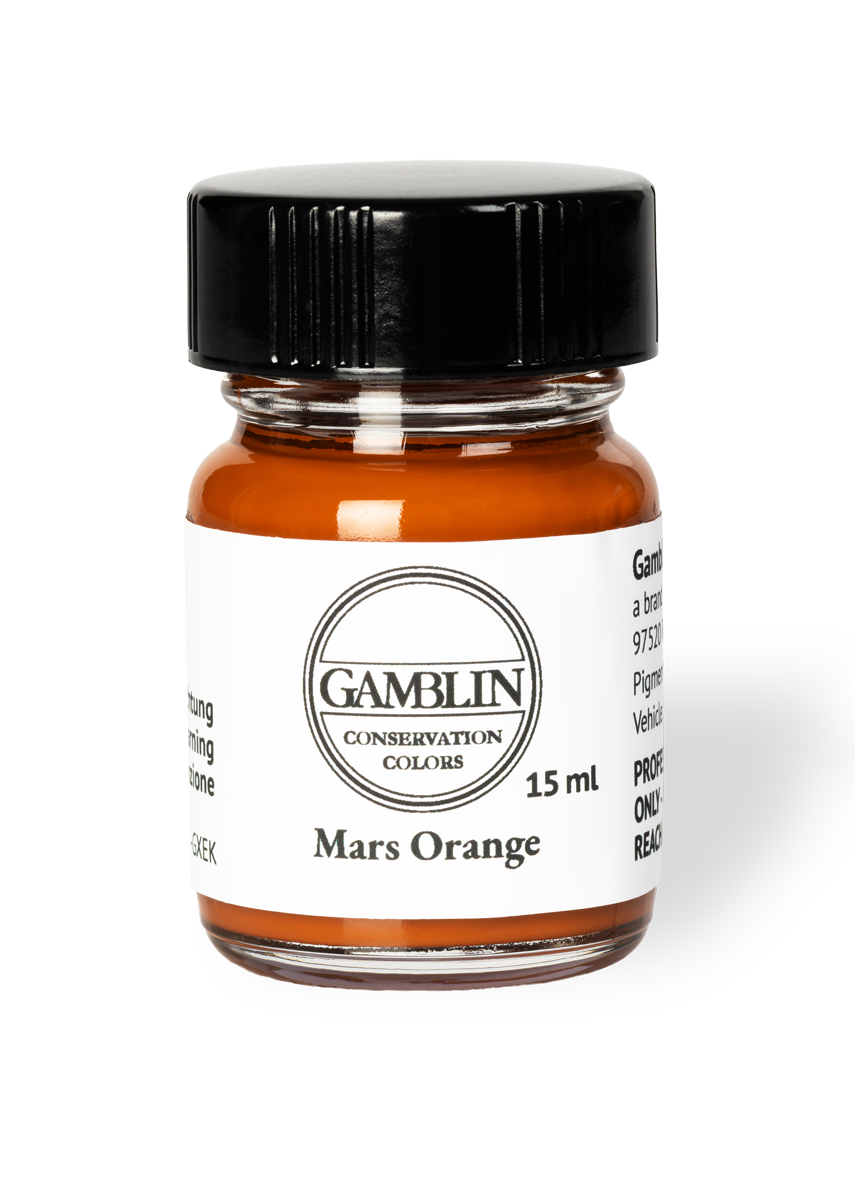
Our color selection is Mars Orange, Venetian Red, and Indian Red.
Safety Data Sheets
Gamblin Conservation Colors SDS, 15 ml jars
→ US – see and download here.
→ EU – see and download here.
Gamblin Conservation Colors SDS, 1/2 pans
→ US – see and download here.
→ EU – see and download here.
